 See album Expos




An ocean of time.
Reflections on the work of Frans Gentils by curator Tim Joye
Artist Frans Gentils has been working since 1960 on the greatest story of our planet, or the story that evolutionary biologist Richard Dawkins calls in his book of the same name “The Greatest Show on Earth.” This story, with an explosive variety of life and depth that surpasses our understanding, does not fit within our popular linear timelines.
In this long story, humans play only a small role. Artist and filmmaker Werner Herzog expresses it like this: “Human civilization is like a thin layer of ice upon a deep ocean of chaos and darkness.”
Gentils’ search reveals authentic perspectives on this deep ocean of time.
His artistry and fascination with monumental time began as a child during the construction of the port of Antwerp, where the enormous sandy construction pits left deep impressions.
When the very young Gentils stumbled upon fossils, these impressions, in a way, beganto burst open in his thoughts in a way that can still be seen in his work today.
It has, as the artist himself says, shaped his worldview.
The Port of Antwerp, once a playground for Gentils, is now an essential part of our modern consumer culture. The artist literally saw the port explode due to ‘containerization,’ with all the consequences we now know.
The largest container ships docking there today carry up to 200,000 tons of goods and consume 300 tons of bunker oil per day, the most polluting fuel of its kind.
The “fossil” journey, however, does not stop at the docks but continues into our homes without us having seen all the hidden guts of our economy.
Since the first commercial extraction of oil 150 years ago, humanity has pumped 2 trillion (2,000,000,000,000) barrels of oil from the Earth’s crust.
This rate stands in stark contrast to the tens of millions of years nature needs to turn plankton and a algae being converted into petroleum, which points to a scale of unprecedented injustice.
Gentils sensed this even before the first environmental associations emerged.
In our human history, or the ‘Anthropocene,’ the disruption we cause to ecosystems is comparable to the power of a meteorite impact or volcanic eruption that precedes a wave of extinction.
Today, the 8 billion people have become a geological force that scientists say is causing the ‘sixth mass extinction.’ That this is caused by a mammal is unprecedented in Earth’s history.
These feelings, which arose in Gentils’ youth, are perhaps most beautifully captured in the monumental work ‘Iguanodons I’ (on loan from the province of East Flanders).
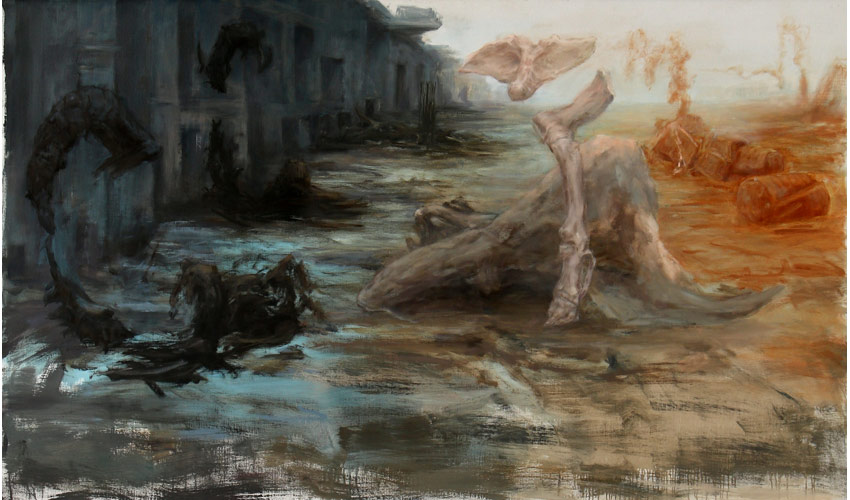
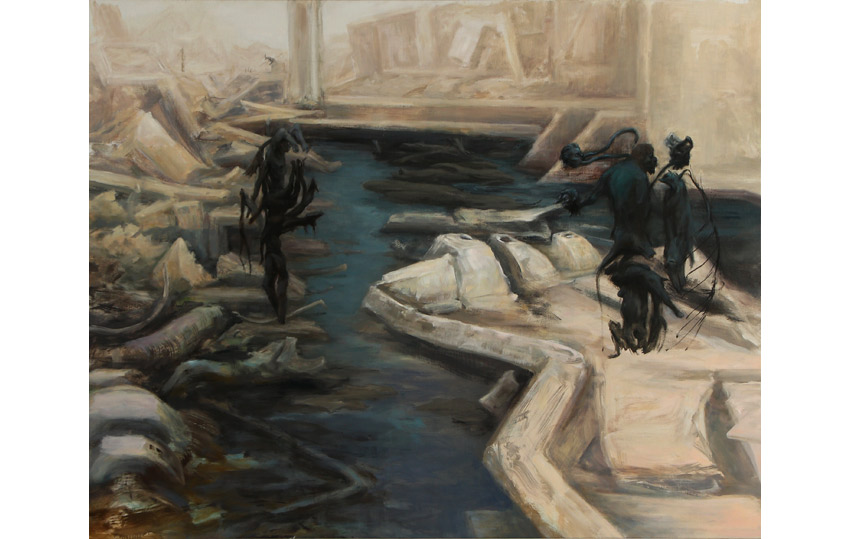
This work, drawn on a sail during the artist’s many wanderings in industrial factories, shows a large factory space in which dinosaur skeletons from the coal of Bernissart seem to floating on a glowing mass of factory rubble. He drew this with a bubbling texture and light that reminds one of a churning ocean.
The work radiates a mystique and monumentality that evokes a sense of stillness, similar to visiting a cathedral.
‘Iguanodons I’ is, in that sense, Gentil’s interpretation of the cathedral of life, where human architecture drowns in an ocean of time through entropy.
This work contrasts strongly with our Western Catholic background, where Genesis (1:28) states it as follows: ‘Be fruitful and multiply, fill the earth and subdue it; have dominion over the fish of the sea, the birds of the air, and over every living thing that moves on the earth.’
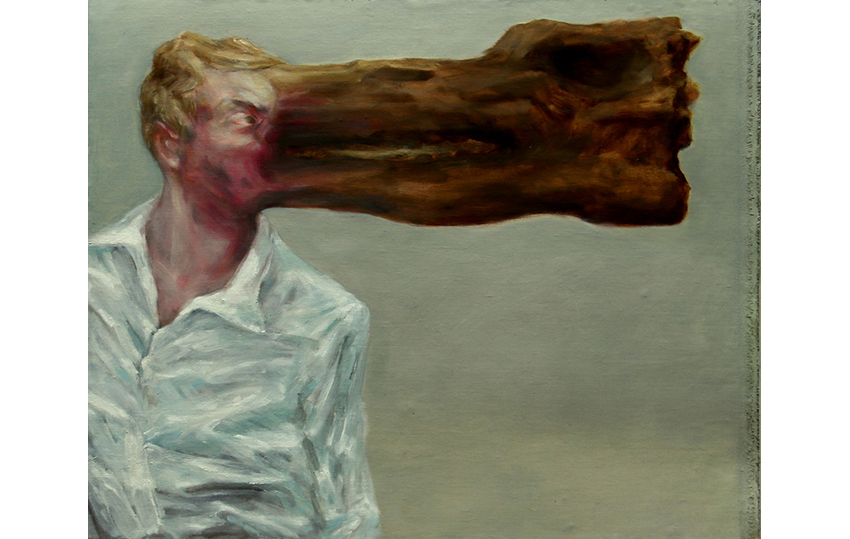
In Gentils’ work, humans sometimes appear, but never with complete dominion over life.
The human figures seem frozen in time, stripped of daily, mundane emotions, and merge in their thoughts with fossils and other organic forms that erupt from their heads.
We should not take these mutations literally, says the artist, but see them in the perspective of evolution.
According to the artist, our thoughts are shaped by the evolutionary processes that preceded us humans in the vast depths of time.
Both our bodies (tailbone, wisdom teeth, …) and our minds and the rituals that stem from them show traces of natural evolution.
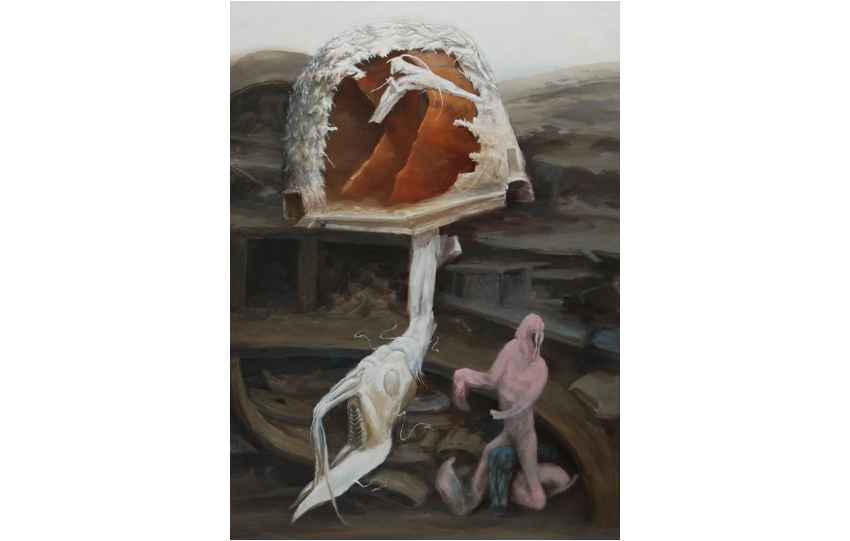
Many traits that we consider exclusively human are also present in other species, such as the mourning behavior of elephants, the cooperation among orcas, the display behavior of peacocks, the playfulness of young lion cubs, or the artistic nest-building of bowerbirds. Gentils’ totems full of life and timescales, combinations of living forms, insects, bones and fossilized remains, and the debris of humanity… mix fragments from different time spans to, among other things, discover patterns in them.
That is certainly relevant today. Scientists on the IPCC Panel (Intergovernmental Panel on Climate Change) try to reconstruct the impact on our climate by comparing today’s time perspective with major events from the past, such as ocean acidification or the current CO2 levels in the atmosphere. They do this by measuring air bubbles in ancient ice or analyzing rocks.
In this way, for example, they find parallels with the Triassic-Perm extinction, 250 million years ago, when 70-90% of all life disappeared. Although this seems like a bleak outlook, we as humans, unlike a clumsy meteorite that can’t be stopped, can still take action to reduce our impact. Or take a radically different course, one that isn’t just focused on growth.
We are forced to, as historian Philipp Blom so beautifully put it, because: ‘It’s too late for pessimism.’ This can be done by creatively and artistically engaging with the biodiversity that still remains and counteracting the effects of warming. Gentils’ work invites us to discover the beauty of this knowledge and embrace it with great playfulness and authenticity, just like life itself.

Iguanodons I
oceaan van tijd.
Reflecties op het werk van Frans Gentils door curator Tim Joye
Kunstenaar Frans Gentils werkt sinds 1960 aan het grootste verhaal van onze planeet, of het verhaal dat evolutionair bioloog Richard Dawkins in zijn gelijknamige boek “The greatest show on earth” noemt. Dit verhaal, met een explosieve verscheidenheid aan leven en diepgang die ons begrip overstijgt, past niet binnen onze populaire lineaire tijdschalen.
In dit lange verhaal speelt de mens slechts een kleine rol. Kunstenaar en filmmaker Werner Herzog drukt het als volgt uit: “Human civilization is like a thin layer of ice upon a deep ocean of chaos and darkness.”
Gentils’ zoektocht onthult authentieke perspectieven op deze diepe oceaan van tijd. Zijn kunstenaarschap en fascinatie voor monumentale tijd begon als kind tijdens de aanleg van de Antwerpse haven, waar de enorme zanderige bouwputten diepe indrukken achterlieten. Toen de piepjonge Gentils op fossielen stuitte, begonnen deze indrukken als het ware in zijn gedachten open te barsten op een manier die tot op vandaag in zijn werk te zien zijn. Het heeft, zoals de kunstenaar zelf zegt, zijn wereldbeeld gevormd.
De Antwerpse haven, ooit een speeltuin voor Gentils, is nu een essentieel onderdeel van onze moderne consumptiecultuur. De kunstenaar zag de haven letterlijk exploderen door de ‘containerisatie’, met alle gevolgen die we nu kennen. De grootste containerschepen die er nu aanmeren, vervoeren tot 200.000 ton goederen en verbruiken 300 ton per dag bunkerolie, de meest vervuilende brandstof in zijn soort. Het “fossiele” traject stopt echter niet aan de dokken, maar gaat verder naar onze huizen zonder dat wij al de verborgen ingewanden van onze economie hebben gezien .
Sinds de eerste commerciële ontginning van olie, 150 jaar geleden, heeft de mensheid 2 biljoen (2.000.000.000.000) vaten olie uit de aardkorst gepompt. Deze snelheid staat in schril contrast met de tientallen miljoenen jaren die de natuur nodig heeft om plankton en algen om te zetten in aardolie, wat wijst op een schaal van ongekende onrechtvaardigheid. Gentils voelde dit al aan voordat de eerste milieuverenigingen ontstonden.
In onze menselijke geschiedenis, of het “Antropoceen”, is de verstoring die we aan de ecosystemen aanrichten vergelijkbaar met de kracht van een meteorietinslag of vulkaanuitbarsting die een uitstervingsgolf voorafgaat. Vandaag zijn de 8 miljard mensen uitgegroeid tot een geologische kracht die volgens wetenschappers de ‘zesde massa-extinctie’ veroorzaakt. Dat dit door een zoogdier wordt veroorzaakt, is ongezien in de geschiedenis van de aarde.
Deze gevoelens, ontstaan in Gentils’ jeugd, zijn mogelijks wel het mooiste vastgelegd in het monumentale werk “Iguanodons I” (in bruikleen bij de provincie Oost-Vlaanderen). Dit werk, getekend op een zeil, tijdens de vele zwerftochten van de kunstenaar in industriële fabrieken, toont een grote fabrieksruimte waarin dinosaurus-skeletten uit de steenkool van Bernissart lijken te drijven op een oplichtende massa van fabriekspuin. Hij heeft dit getekend met een bruisende textuur en licht die doet denken aan een kolkende oceaan. Het werk straalt een mystiek en monumentaliteit uit die een verstilling uitlokt, vergelijkbaar met een bezoek aan een kathedraal. “Iguanodons I” is in die zin Gentils interpretatie van de kathedraal van het leven, waarin de menselijke architectuur via entropie in een oceaan van tijd verdrinkt.
Dit werk contrasteert sterk met onze Westerse katholieke achtergrond, waarin Genesis (1:28) het als volgt stelt: “Wees vruchtbaar en word talrijk, vervul de aarde en onderwerp haar; heerschappij over de vissen van de zee, de vogels van de lucht en over alle levende wezens die op de aarde bewegen.”
In Gentils’ werk komt de mens soms wel naar voren, maar nooit met volledige heerschappij over het leven. De menselijke figuren lijken bevroren in de tijd, ontdaan van dagelijkse, banale emoties en versmelten in hun gedachten met fossielen en andere organische vormen die uit hun hoofd schieten.
We mogen deze mutaties niet letterlijk nemen, zegt de kunstenaar, maar zien in het perspectief van de evolutie. Volgens de kunstenaar zijn onze gedachten gevormd door de evolutionaire processen die ons, mensen voorgingen in de grote dieptes van de tijd.
Zowel ons lichaam (staartbeentje, verstandskiezen, …) als onze geest en de rituelen die daaruit voortkomen, tonen sporen van de natuurlijke evolutie. Veel eigenschappen die we als exclusief menselijk beschouwen, zijn ook aanwezig bij andere soorten, zoals het rouwgedrag van olifanten, de samenwerking tussen orka’s, het imponeergedrag van pauwen, de speelsheid van jonge leeuwenwelpen, of het artistieke inrichten van nesten door prieelvogels. Gentils totems vol leven en tijdschalen, combinaties van levende vormen, insecten, botten en versteende fossielen, en het puin van de mensheid… vermengen fragmenten uit diverse tijdspannes om er, onder andere, patronen in te ontdekken.
Dat is vandaag zeker relevant. Wetenschappers in het IPPC Panel (Intergovernmental Panel on Climate Change) proberen de impact van ons klimaat te reconstrueren door het tijdsperspectief van vandaag te vergelijken met grote gebeurtenissen uit het verleden, zoals de verzuring van de oceanen of het huidige CO2-gehalte in de atmosfeer. Ze doen dit door luchtbellen in oud ijs te meten of gesteenten uit te lezen. Op die manier vinden ze bijvoorbeeld parallellen met de Trias-Perm-extinctie, 250 miljoen jaar geleden, toen 70-90% van alle leven verdween.Hoewel dit een somber vooruitzicht lijkt, kunnen wij als mensen, in tegenstelling tot een lompe meteoriet die niet te stoppen is, nog actie ondernemen om onze impact te verminderen. Of een radicaal andere koers te nemen, die niet enkel op groei is gericht.
We zijn ertoe gedwongen, zoals historicus Philipp Blom het zo mooi stelde, want:‘het is toch te laat voor pessimisme’. Dit kan door creatief en artistiek om te gaan met de biodiversiteit die ons nog rest en de effecten van de opwarming tegen te gaan.
Het werk van Gentils nodigt ons uit om de schoonheid van deze kennis te ontdekken en met een grote speelsheid en authenticiteit, zoals het leven zelf, te omarmen.